Ever walked into your steel shed on a hot summer afternoon and felt like you’d stepped into an oven?
You’re not imagining it. Steel sheds can become noticeably warmer during summer, especially when the roof and walls are exposed to direct sunlight and there’s limited airflow inside.
Whether you’re storing farm machinery, working on the ute, or keeping your boat and tools under cover, understanding why steel sheds get hot in summer can help you make better decisions about ventilation, insulation and shed design.
Here’s what’s happening and what you can do about it.
Why Do Steel Sheds Get So Hot?
The main reason is solar heat gain.
When sunlight hits a steel shed, the roof and wall cladding absorb some of that solar energy. The metal heats up and transfers heat towards the interior through conduction, radiation and air movement.
Steel conducts heat readily, which means an uninsulated metal roof can transfer heat into the space beneath it relatively quickly.
Several factors influence how hot the shed becomes:
- Direct sunlight: Roofs and walls exposed to the sun absorb heat throughout the day.
- Roof colour: Darker surfaces generally absorb more solar energy than lighter ones.
- Insulation: Without suitable insulation, heat can pass more readily through the building envelope.
- Ventilation: Warm air may accumulate when there isn’t enough air exchange.
- Building location: Local temperatures, wind conditions and sun exposure all affect the result.
The roof is often a major contributor because of its exposure to sunlight.
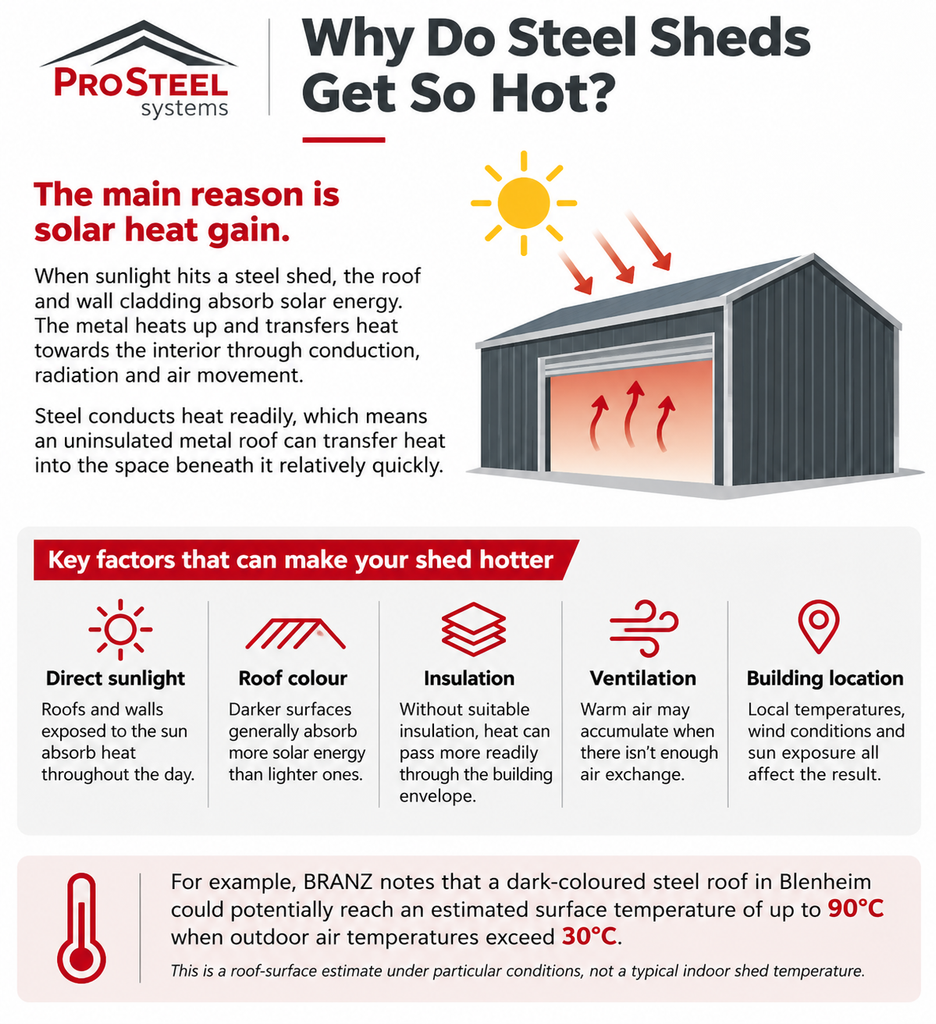
According to BRANZ’s guidance on roof design, metal roofing can experience substantial temperature changes. BRANZ gives an illustrative example of a dark-coloured steel roof in Blenheim potentially reaching an estimated surface temperature of 90°C when outdoor air temperatures exceed 30°C.
That’s a roof-surface estimate under particular conditions, not a typical indoor shed temperature. But it illustrates why roof design matters.
Does New Zealand’s Summer Climate Make a Difference?
Absolutely.
New Zealand might have a generally temperate climate, but summer conditions vary considerably between regions.
According to Earth Sciences New Zealand’s overview of the country’s climate, January and February are typically the warmest months, and inland areas can experience greater temperature variations than coastal locations.
In Canterbury, for example, hot north-westerly conditions can push summer temperatures above 30°C. This is documented in Earth Sciences New Zealand’s Canterbury climatology.
That matters if you’re planning a shed in Christchurch, rural Canterbury or elsewhere in the South Island.
A workshop in inland Canterbury may have different cooling and ventilation needs from a storage shed in coastal Auckland or a building in Southland.
It’s not just about how hot the region gets. Local wind patterns, shade, humidity and how the building is positioned all make a difference.
1. Your Steel Roof Absorbs Heat From the Sun
Think about a car parked outside on a sunny afternoon.
The bodywork heats up under direct sunlight. Steel roofing behaves similarly, although the actual temperatures depend on the roof’s colour, finish, exposure and surrounding conditions.
As the roof becomes hotter, heat can transfer towards the inside of the shed.
If the roofing is uninsulated, that heat can be felt by people working underneath it, even before the indoor air has warmed significantly.
This is one reason roof design deserves attention when planning a steel shed.
Does Roof Colour Affect Shed Temperature?
Yes.
Lighter-coloured roofing generally reflects more sunlight, while darker colours tend to absorb more solar energy.
New Zealand’s Ministry of Business, Innovation and Employment (MBIE) identifies reflective roof colours as one way to reduce summer heat gain in its passive cooling guidance.
However, a lighter roof isn’t automatically the best choice for every building.
Recent BRANZ research into metal roof colour and condensation found that lighter-coloured roofs experienced higher relative humidity during certain periods, particularly in winter, in the roof assemblies studied.
The takeaway? Roof colour should be considered alongside insulation, ventilation, moisture management and the local climate.
2. Warm Air Can Build Up Inside the Shed
Another reason steel sheds become uncomfortable is limited ventilation.
As the roof and walls heat up, the air inside can become warmer. Without sufficient airflow, that heat may remain trapped in the building.
Warm air is less dense than cooler air, so it tends to rise. This can contribute to higher temperatures around the upper parts of the shed.
If the building has no suitable way for that air to escape, heat can accumulate.
Why Isn’t Opening the Roller Door Always Enough?
Opening a large roller door can improve airflow, especially when there’s a breeze.
But it may not provide effective ventilation throughout the entire building.
For example, if a shed has only one large opening, airflow may be limited in areas farther from the door.
The direction of the wind and the placement of other openings also matter.
MBIE’s passive ventilation guidance explains how openings on different sides of a building can encourage cross-ventilation, while higher openings can allow rising warm air to escape.
These principles can help inform shed planning, although the guidance is primarily written for residential buildings.
Something to remember: Ventilation doesn’t actively refrigerate the air. If it’s hotter outside than inside, increasing airflow may not reduce the indoor air temperature. However, air movement can still improve comfort for people working in the shed.
3. Your Shed Might Not Have Enough Insulation
Insulation is another factor that affects how quickly heat enters a steel shed.
Without suitable insulation, heat from the roof and walls can pass into the interior more readily.
Insulation slows this heat transfer.
For a shed used as a workshop, garage or regularly occupied workspace, that can make a difference to summer comfort.
Depending on the building, possible options include:
- Roof insulation systems.
- Insulated roofing or wall panels.
- Wall insulation for areas requiring additional thermal control.
The right approach depends on the building’s construction and intended use.
MBIE’s passive cooling recommendations identify insulation as an important way to reduce unwanted heat entering a building.
However, insulation isn’t an air conditioner.
It slows heat transfer rather than actively lowering the temperature. Once the interior becomes hot, insulation can also slow the rate at which that heat escapes.
That’s why insulation and ventilation are best considered together.
4. Your Shed’s Position Can Affect How Hot It Gets
Where you place your shed can influence how much sunlight reaches the building throughout the day.
In New Zealand, the sun tracks across the northern part of the sky. North-facing surfaces can receive substantial sunlight, while west-facing walls and openings may be exposed to strong afternoon sun.
If you’re planning a new shed, consider:
- Which walls receive direct afternoon sunlight.
- Whether the building has any natural shade.
- Where the prevailing winds come from.
- Whether doors and windows can be positioned to encourage airflow.
- How the shed’s intended use affects the layout.
For example, a workshop with its main opening facing strong afternoon sunlight may become uncomfortable when the door is left open.
But positioning isn’t just about managing heat.
You’ll also need to think about access, drainage, ground conditions, boundaries and any applicable planning requirements.
A shed should be designed around the property as a whole, not just where it looks best.
5. Skylights and Windows Can Add More Heat
Natural light is useful, particularly if you’re planning to use your shed as a workshop.
But windows and translucent roof panels can also allow solar energy to enter the building.
Large areas of glazing exposed to direct sunlight may increase indoor temperatures.
That doesn’t mean you should avoid windows or skylights altogether.
It means considering their placement, size and specifications.
Depending on the building’s design, suitable options may include:
- Positioning windows away from excessive direct afternoon sunlight.
- Incorporating shading where practical.
- Choosing glazing with appropriate solar-control properties.
- Balancing natural light with ventilation and insulation.
MBIE’s H1/AS2 energy-efficiency guidance for buildings over 300m² also identifies window area, skylights, shading, thermal resistance and ventilation as considerations for controlling solar heat gain.
The specific regulatory requirements depend on the building’s classification and scope. Not every shed is subject to the same energy-efficiency provisions.
Is It Normal for a Steel Shed to Feel Hotter Than Outside?
It can happen, particularly in an uninsulated shed exposed to strong sunlight.
The roof and walls may become much hotter than the surrounding air. These surfaces can radiate heat towards people and objects inside the building, making the space feel uncomfortable.
If ventilation is limited, the indoor air temperature may also rise above the outdoor temperature.
However, this isn’t inevitable for every steel shed.
The difference depends on the building’s construction, solar exposure, insulation, ventilation and weather conditions.
A steel shed can be designed with features that help manage summer heat. The important thing is understanding what the building will be used for before finalising its specifications.
How Can You Reduce Heat Inside a Steel Shed?
If you’re planning a new shed, or already have one that becomes uncomfortable in summer, there are several options worth considering.
| What to consider | How it may help |
|---|---|
| Ventilation | Helps remove accumulated warm air when outdoor conditions are suitable |
| Roof insulation | Slows heat transfer through the roofing system |
| Wall insulation | Reduces heat transfer through exposed walls |
| Roof colour | Lighter finishes generally reduce solar heat absorption |
| Shading | Limits direct solar heat gain through openings |
| Fans | Improve air movement and personal comfort |
| Building orientation | Helps manage sun exposure and natural airflow |
Not every shed needs all these features.
A farm shed used primarily for machinery storage may have different requirements from a workshop where someone spends several hours a day.
If you’re using the building as a workplace, temperature management also becomes a health and safety consideration.
WorkSafe New Zealand’s workplace requirements state that workplaces must have sufficient ventilation to provide safe, clean air and that workers must be protected from temperature extremes.
For existing sheds, seek appropriate advice before modifying roof or wall cladding, installing permanent vents or changing insulation systems. Alterations can affect structural performance, weathertightness and moisture management.
Planning a New Steel Shed? Consider Summer Comfort Before You Build
It’s easy to focus on dimensions, roller doors and storage capacity when planning a shed.
Those are important decisions, but so is thinking about what it’ll feel like to use the building throughout the year.
A shed used mainly for storage may have different requirements from one that will become a workshop or commercial workspace.
Before finalising your design, think about:
- How often you’ll be working inside.
- Whether the shed will remain closed during the day.
- What equipment or materials you’ll store.
- Whether insulation or ventilation should be incorporated.
- How the building’s use might change in the future.
At ProSteel Systems, we work with New Zealand customers planning everything from rural storage sheds and garages to workshops and custom steel buildings.
Whether you’re considering a Baseline kitset shed or a custom design, discussing how you’ll use the building early can help identify which features are worth considering.
Frequently Asked Questions
Why Does My Steel Shed Feel Like an Oven in Summer?
Steel roofing and wall cladding absorb solar energy and can become significantly hotter than the surrounding air. Heat then transfers towards the interior. Without suitable insulation, shading or ventilation, the shed can become uncomfortable.
Does a Dark-Coloured Steel Shed Get Hotter?
Dark-coloured roofing generally absorbs more solar energy than lighter-coloured roofing. However, the actual indoor temperature also depends on insulation, ventilation, local weather conditions and the building’s design.
Will Insulating My Steel Shed Stop It From Getting Hot?
Insulation can reduce the rate of heat transfer through the roof and walls, but it won’t eliminate summer heat or actively cool the building. Ventilation, shading and other measures may also be needed.
Does Opening a Roller Door Cool Down a Shed?
It can help when outdoor air is cooler or when there’s enough airflow to remove accumulated heat. However, a single opening may not provide effective ventilation throughout a large building.
Can I Add Ventilation to an Existing Steel Shed?
Ventilation improvements may be possible, but the right solution depends on the shed’s structure and construction. Seek professional advice before cutting new openings or altering roofing and cladding.
Are Steel Sheds Suitable for Workshops in New Zealand?
Yes. Steel sheds can be designed for workshop use, but the requirements should be considered early. Depending on the intended activities, this may include insulation, ventilation, lighting, power, equipment clearances and any applicable building or workplace requirements.
Build a Steel Shed That Works Beyond Summer
A hot shed isn’t necessarily something you have to put up with.
Understanding how sunlight, roofing, insulation and airflow affect the interior can help you make more informed decisions when planning your building.
And while summer heat is worth considering, your shed also needs to suit New Zealand’s year-round conditions, including wind, rain and the site’s specific exposure.
Planning a steel shed, garage or workshop?
Tell the ProSteel team what you’re building, where it’s going and how you intend to use the space.
We’ll help you work through your options and plan a building that makes sense for your property.
Get in touch with ProSteel Systems
Website: www.prosteelsystems.co.nz
Email: info@prosteelsystems.co.nz
Phone: 021 288 3122